We evaluated ergonomic task chairs across multiple brands, scoring each on adjustability range, lumbar support quality, seat construction, weight capacity, long-term commercial durability, and value relative to price. These are not sponsored picks or manufacturer recommendations — they are selections drawn from more than 30 years of furnishing commercial offices, call centers, medical facilities, and government workstations. Each pick represents the chair our specialists recommend most confidently in its use-case segment.
| Pick | Product | Back Material | Weight Cap. | Best For |
|---|---|---|---|---|
| Best Overall | Coolmesh Pro High Back Ergo Chair — PBD Furniture | Rugged Fabric | 275 lbs | All-day commercial use |
| Best Value | 3D Mesh Fabric Back Covers for Nuve Chair — PBD Furniture | 3D Mesh | — | Nuve chair upgrade |
| Best Budget | Armless Task Chair — WFB Designs | Fabric | — | Secondary workstations, tight budgets |
| Best Premium | Low Back Ergohuman Chair — Eurotech | Fabric | — | Maximum ergonomic precision |
| Most Popular | Mesh Back Managers Chair — PBD Furniture | Mesh | — | Modern offices, managers |
| Runner-Up | Mesh Seat & Back Task Chair with Headrest — WFB Designs | Matrix Mesh | — | Full-day support with headrest |
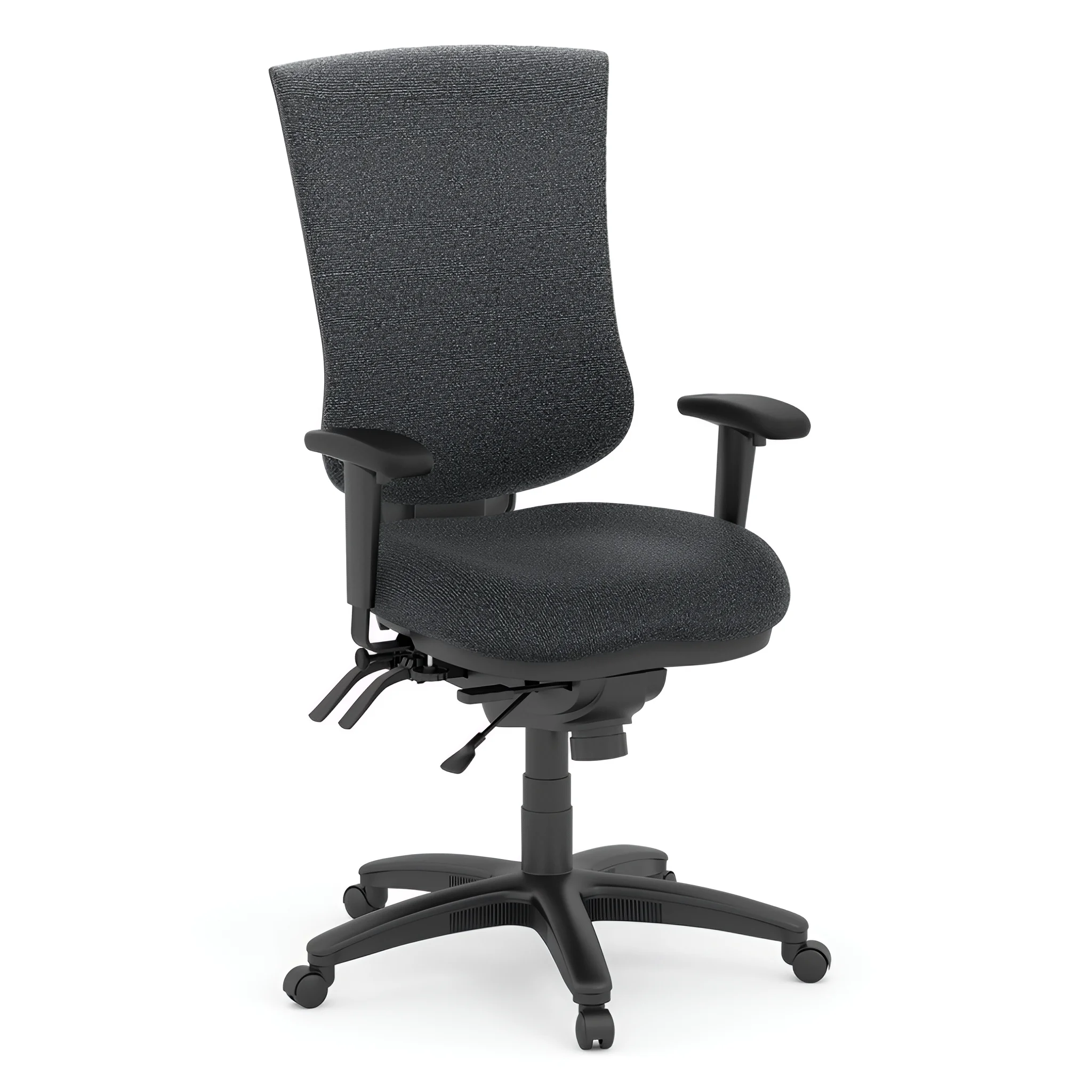
The Coolmesh Pro High Back Ergo Chair earns the Best Overall pick by delivering a comprehensive ergonomic adjustability package — seat and back angle, tilt tension, multi-position tilt lock, forward seat tilt, seat slider, seat height, arm height, arm width, and adjustable lumbar support — in a chair built to commercial weight standards at a price point that makes outfitting an entire office viable. The 275-pound weight capacity covers the large majority of commercial users and contributes to the structural longevity of the chair under all-day, five-days-a-week loading. At 49 pounds assembled, this is a substantial piece of seating equipment with the mass to match.
The rugged fabric upholstery on both seat and back is a deliberate commercial choice. Where mesh backs excel in warm environments, fabric provides a more consistent feel across temperature ranges and resists the wear patterns that can develop on mesh under repetitive heavy use. The “rugged” designation is meaningful here — PBD specifies a commercial-grade fabric that holds up under the daily contact that a task chair in a busy office environment receives. The comprehensive arm adjustment — height and width — means this chair can be properly fitted to users of widely varying builds, which is exactly what a shared workstation or open-plan office requires.
For facilities managers and office administrators purchasing task chairs for commercial environments, the Coolmesh Pro is the recommendation that minimizes callback complaints and replacement frequency. with free shipping and a Lifetime Warranty, the total cost of ownership over a 7–10 year commercial service life is among the most favorable in its class. Ships in five business days.
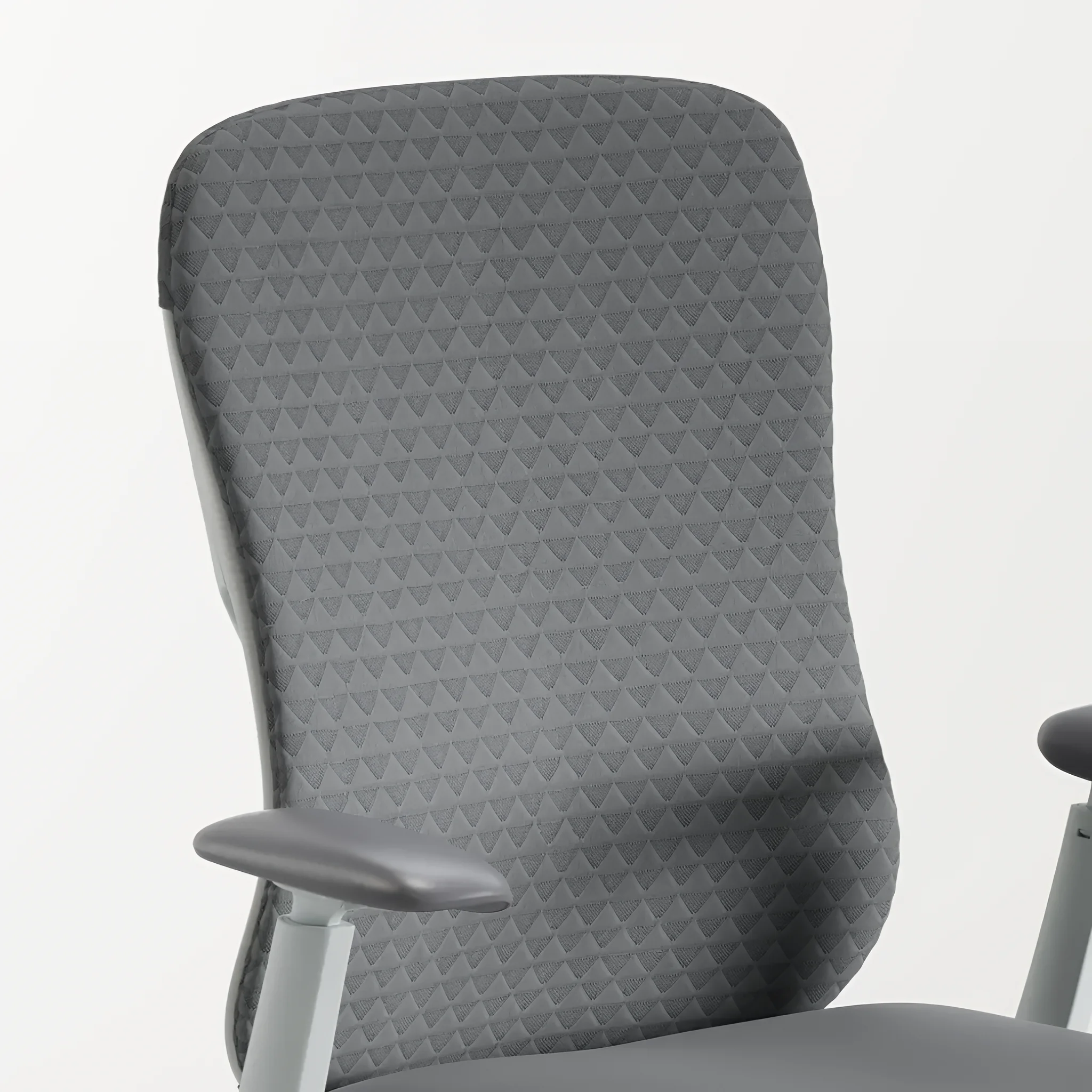
The 3D Mesh Fabric Back Covers for the Nuve Chair represent the most cost-effective ergonomic upgrade available for organizations that already have Nuve chairs in their inventory. Designed specifically for the Nuve’s plastic flex-back panel, these slip-on covers add a 3D mesh fabric surface that delivers a softer contact feel while preserving the full range of the Nuve’s signature “moves with you” back flex. For offices where the Nuve is already the standard task chair, this is a practical refresh that adds comfort and visual appeal without replacing functional chairs that still have years of service life remaining.
The Best Value designation here is specific: these covers only apply to organizations that own Nuve chairs. If you are purchasing new, the Coolmesh Pro or the Astra Manager Chair are the more appropriate starting points. But for a facilities manager looking to extend the useful life and perceived quality of existing Nuve inventory — particularly in client-visible areas or after a workspace renovation — this upgrade delivers a noticeably improved experience per chair. Colors are coordinated with the Nuve fabric seat options, ensuring a cohesive appearance across the chair.
These covers ship ready to slip on — no tools, no hardware, no assembly. per set, they are the most economical ergonomic improvement per dollar available in our catalog for Nuve chair owners. Ships in five business days with free delivery and our Free Lifetime Warranty.
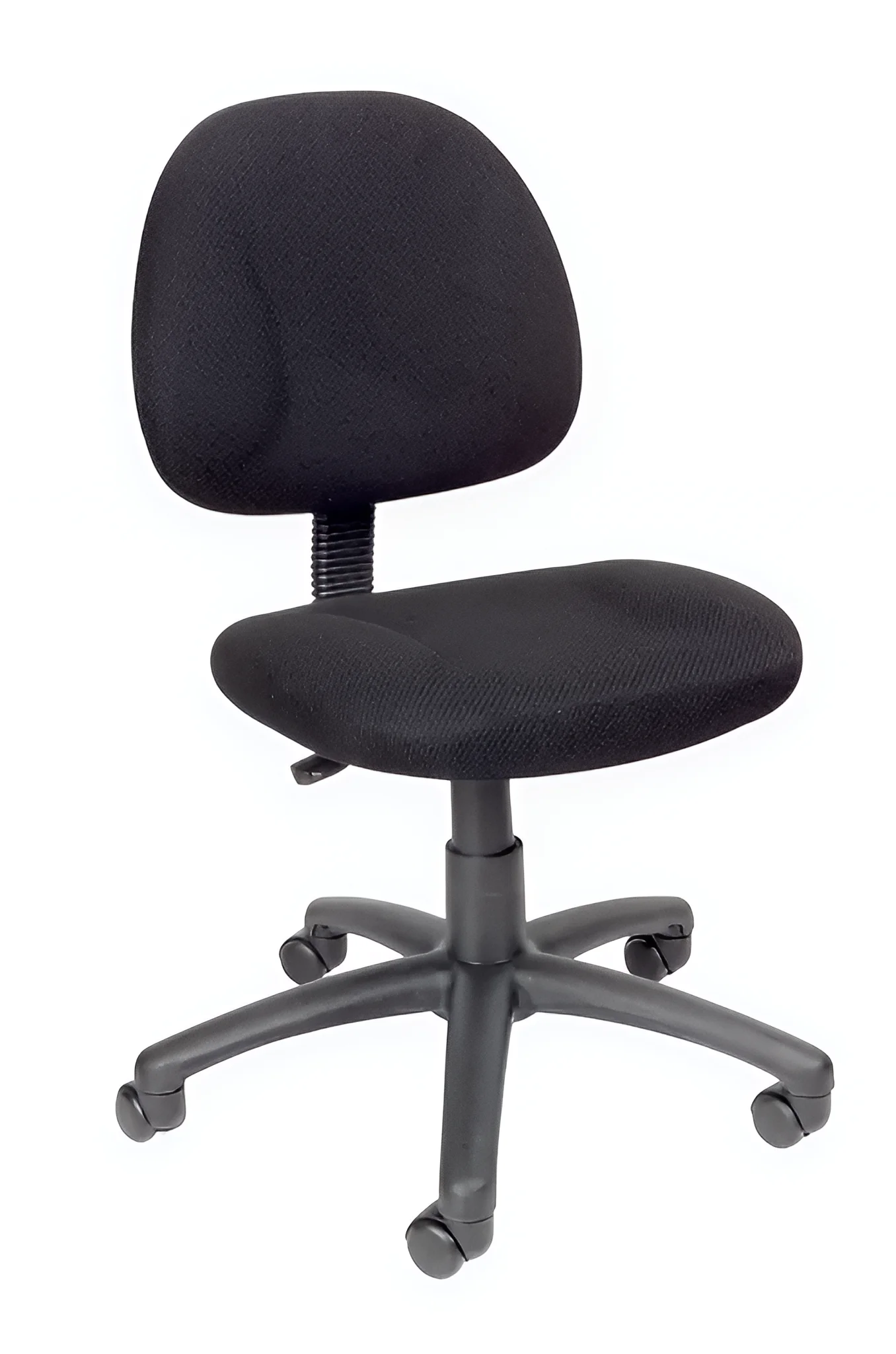
The WFB Designs Armless Task Chair, built on a Boss Seating ergonomic platform, earns the Best Budget position by offering a purpose-designed ergonomic task seat — a price that makes it viable for secondary workstations, training rooms, overflow seating, or startup offices where the primary seating budget is constrained. Boss Seating specializes in ergonomic chair design and manufacturing, which means this is not a general-purpose office chair that happens to be armless — it is engineered for seated task work with the appropriate seat pan depth, cushion density, and lumbar support geometry that task chairs require.
The armless configuration is a deliberate feature for specific applications. In compact workstations where armrests would prevent the user from pulling close to the desk, armless chairs are the correct specification. Training rooms and computer labs often specify armless task chairs to maximize seat density along shared worktables. At 23 pounds and 17 inches wide, this chair is also unusually compact, which makes it easy to move and store when the room layout needs to change. The black fabric upholstery is a neutral commercial finish that coordinates with virtually any office color palette.
For buyers who need a reliable, ergonomically appropriate task chair at an accessible entry price, this Boss-platform WFB Designs model delivers genuine seated-work functionality. It is not a substitute for the Coolmesh Pro in a primary commercial workstation, but in every secondary-use scenario where ergonomics still matter and budget is the binding constraint, this chair performs well above its price point. Ships in five business days with free delivery and our Free Lifetime Warranty.
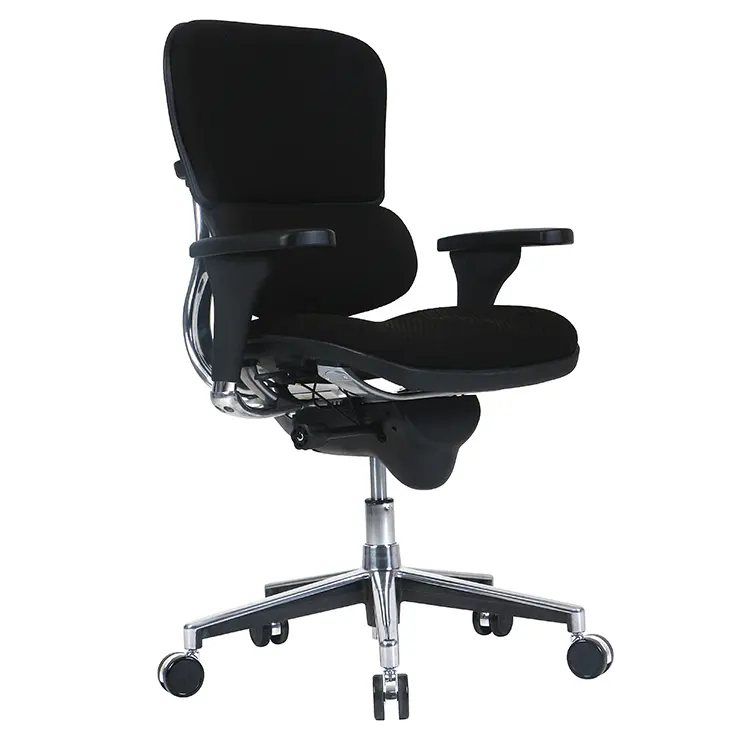
Eurotech’s Low Back Ergohuman Chair is the Best Premium pick for buyers who require the most precise ergonomic fine-tuning available in a task chair at this price tier. The Ergohuman was engineered from first principles around ergonomic performance, and the adjustability range reflects that: tilt tension control and tilt lock, back angle adjustment, seat height, waterfall seat edge, back height adjustment, seat depth adjustment from 18.5 to 22.2 inches, and swivel arms with height adjustment. The seat depth range alone — 3.7 inches of travel — is wider than most chairs in this price category, which matters for users at the extremes of the seated height range where standard seat depths create either popliteal pressure or inadequate thigh support.
At 66 pounds, the Ergohuman is a structurally substantial chair that communicates quality from the moment you sit in it. The aesthetic — clean geometric forms, visible mechanism components, refined black frame — is the language of serious ergonomic engineering rather than decorative office furniture. Eurotech has built the Ergohuman platform to serve users who sit for extended hours in demanding concentrated-work environments: software engineers, attorneys, financial analysts, and others for whom seating discomfort is a direct productivity cost. For these users, this investment is recouped quickly in reduced fatigue and sustained focus.
The low-back configuration is the appropriate choice for users who prefer unobstructed shoulder movement and work in environments where a high-back chair would feel visually heavy. For users who want head and neck support during extended sessions, the Helena Mesh Chair with Headrest (Runner-Up below) is the alternative to consider. Ships in five business days with free delivery and our Free Lifetime Warranty.
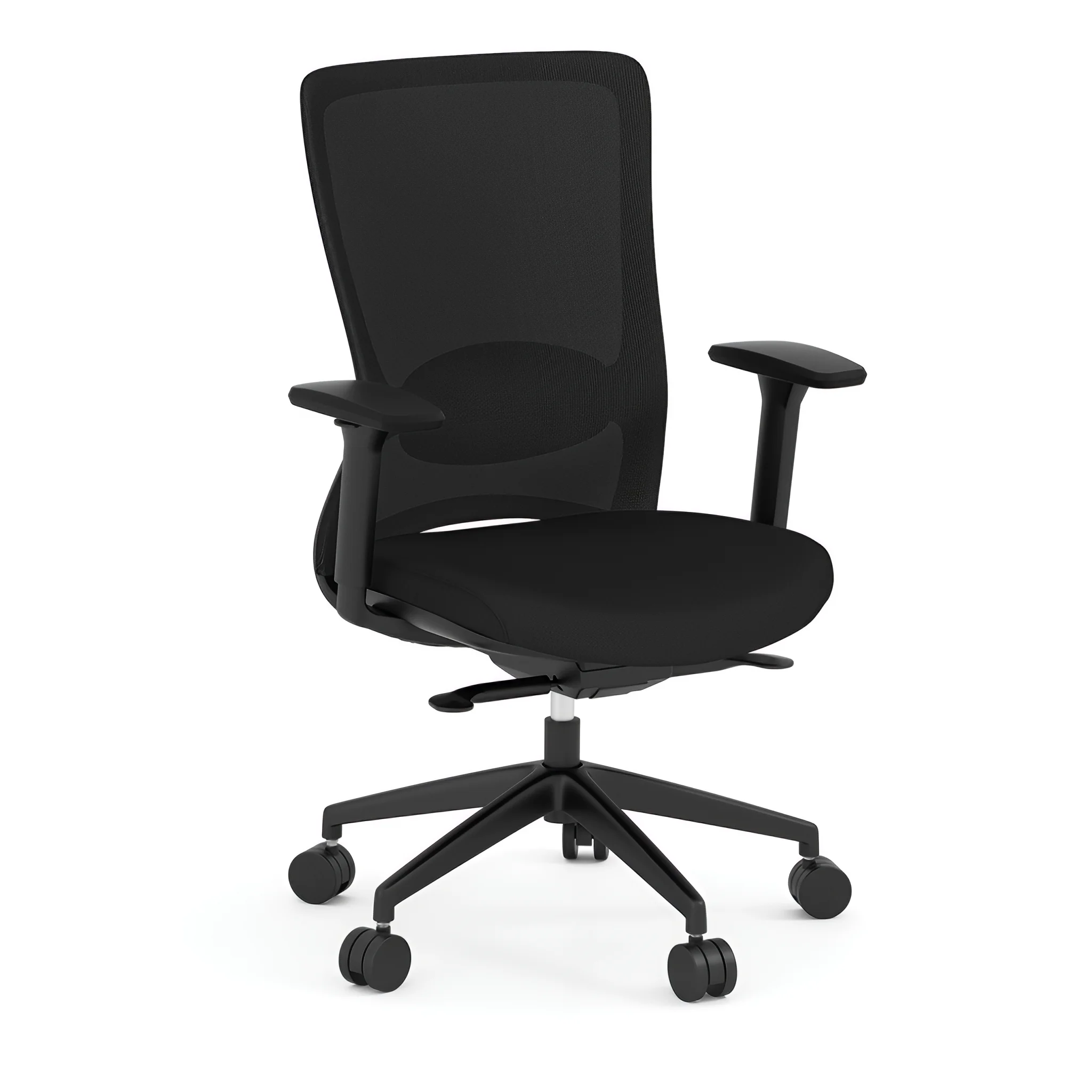
The PBD Furniture Astra Collection Mesh Back Manager’s Chair is the most ordered ergonomic task chair in its price tier in our catalog, and the reason is clear: it combines the aesthetic of a premium mesh chair — breathable mesh back, tailored fabric seat, refined black frame — with a control set that covers the full range of ergonomic adjustments that a manager or professional requires in their primary work chair. Dynamic height-adjustable lumbar that moves with the user, 3-way adjustable arms (height, depth, and angle), seat slider for seat depth customization, and 3-stage synchro-tilt with lock all appear on this chair — a price-to-feature ratio that our specialists find difficult to beat at this tier.
The mesh back is the feature that most consistently drives repurchase in warm or large open-plan offices. Breathable mesh eliminates the heat buildup that fabric and vinyl backs create during extended sitting, which translates directly to user comfort and reduced fatigue in afternoon working hours. The tailored fabric seat provides firmer, more stable support than a full-mesh seat pan, which is the ergonomically correct configuration for all-day work — mesh seats tend to sag and create pressure points over time in a way that high-density foam seats do not. The combination of mesh back and fabric seat is the most widely specified configuration for commercial ergonomic task chairs for exactly this reason.
For managers, supervisors, and knowledge workers who need a chair that performs well ergonomically, looks appropriate in client-visible settings, and does not carry a premium price tag, the Astra Manager Chair is the recommendation we make most often. Ships in five business days, free delivery, Free Lifetime Warranty.
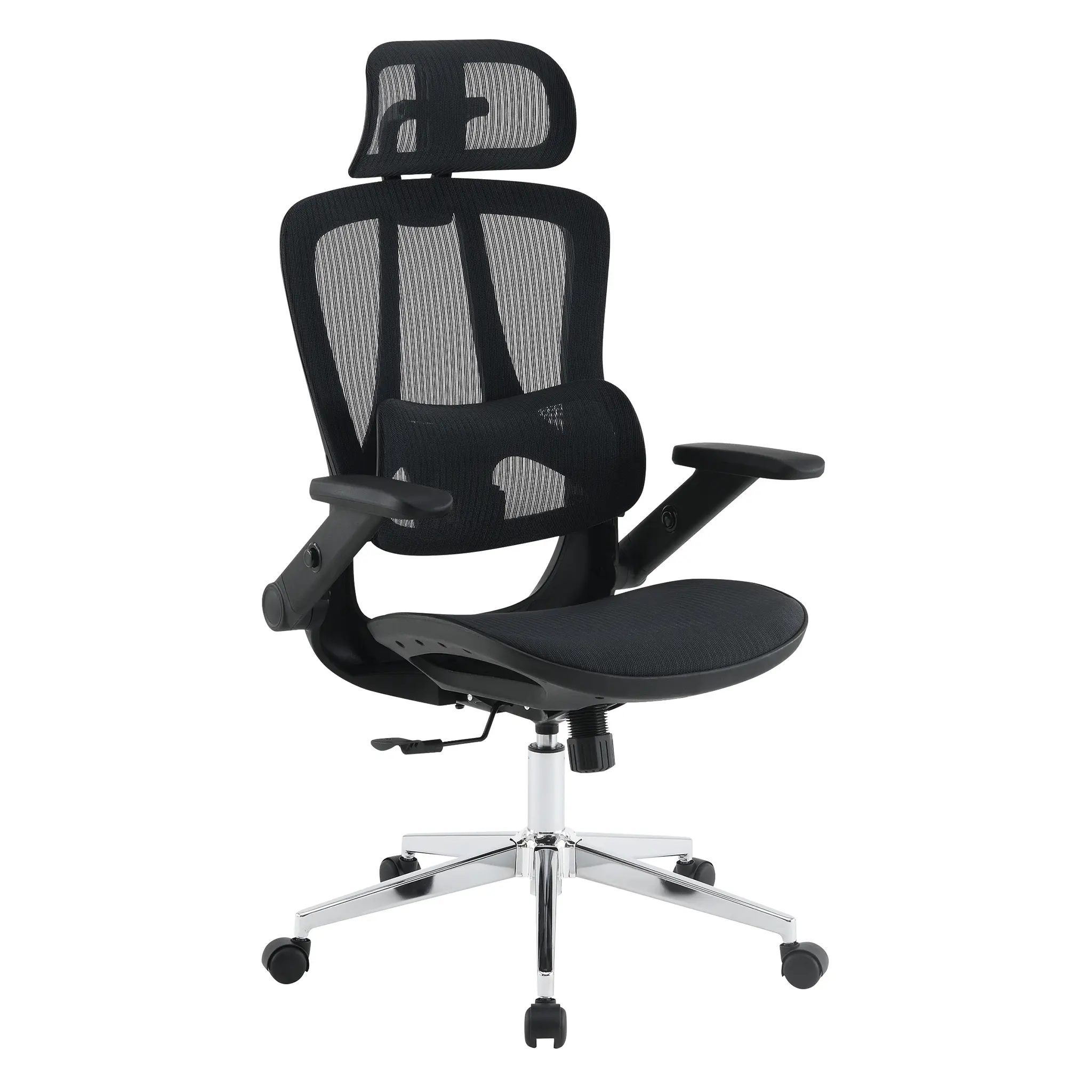
The WFB Designs Helena Collection Mesh Seat and Back Task Chair earns the Runner-Up position for buyers who require both a headrest and the full-body airflow of an all-mesh chair. The combination of an adjustable headrest and a 4D arm system — height, depth, angle, and flip-up capability — gives this chair the most complete adjustment suite of any model in this roundup, and the flip-up arm feature is a practical differentiator: when the arms are not needed for a specific task, they flip back out of the way rather than sitting at desk height where they can prevent the user from pulling fully into the workstation.
The Black Matrix mesh on both seat and back promotes full-body airflow, which is particularly well-suited to environments where climate control is variable or where users consistently report heat discomfort in standard upholstered chairs. The adjustable headrest addresses a genuine ergonomic gap in most commercial task chairs — support for the cervical spine during periods of reclined working or reading, which reduces neck fatigue that contributes to end-of-day tension headaches. The self-adjusting lumbar ensures lower back support without requiring the user to locate and set a fixed lumbar pad position.
with a headrest and 4D arms included, this chair represents strong value for users who need those features. For offices equipping multiple workstations, it sits at a price point close to the Astra Manager Chair, so compare the feature priorities — headrest and flip arms vs. the Astra’s fabric seat and three-stage synchro-tilt — and specify accordingly. Ships in five business days, free delivery, Free Lifetime Warranty.
The single most important ergonomic adjustment is seat height. A proper ergonomic seated position has the feet flat on the floor, knees at approximately 90 degrees, and thighs parallel to the floor or slightly angled downward. Standard task chair seat height ranges from approximately 17 to 21 inches, which covers users from roughly 5’2” to 6’2” at standard desk height. For users outside this range — shorter users who need a footrest at standard desk height, or taller users who require a seat height above 21 inches — verify the specific height range before ordering. Shared workstations benefit most from chairs with the widest available height range.
Adjustable lumbar support — either a pad that moves up and down on the back, or an adjustable depth mechanism — is a non-negotiable feature for any chair intended for all-day commercial use. Fixed lumbar positions are designed around an average user geometry that fits a minority of actual users well. Adjustable lumbar allows each user to position support at their specific lumbar apex, which is the defining difference between a chair that relieves lower back fatigue and one that simply does not create it. Height-adjustable lumbar (like the Astra Manager Chair’s dynamic lumbar system) is the most versatile configuration for shared workstations.
Seat depth — adjusted via a seat slider mechanism — determines how much of the thigh is supported by the seat pan. The correct position leaves 2–3 inches of clearance between the front edge of the seat and the back of the knee (the popliteal fold). Too little seat depth creates thigh pressure that restricts circulation; too much seat depth pushes the user off the back support. Users shorter than 5’4” are most frequently affected by fixed seat depths set for average-sized users. The seat slider is one of the most overlooked ergonomic adjustments on the spec sheet — confirm its presence for any chair going into a workstation used by diverse user populations.
Armrest designation indicates the number of adjustment axes. 2D arms adjust for height and width. 3D arms add a pivot or forward/back depth adjustment. 4D arms add a lateral swing or rotation, enabling the arm surface to angle inward or outward relative to the body. For keyboard-intensive work, 3D adjustable arms are the minimum recommendation: height and width set the arms relative to the desk surface, and depth positions the arm pad below the elbow correctly for wrist alignment. 4D arms are most valuable for users who switch frequently between keyboard work and mouse work, as the angle adjustment can be set differently for each task mode.
A synchro-tilt mechanism links the seat and back recline at a ratio (typically 1:2) so that as the back reclines, the seat tilts slightly upward at the front, maintaining the natural thigh angle and preventing the user from sliding forward. Standard tilt pivots at a single point, usually under the seat front, causing the seat pan to angle downward as the back reclines — which reduces lumbar support contact and causes the user to brace forward. For all-day seated work where periodic recline is a normal working posture, synchro-tilt is the correct mechanism. The Astra Manager Chair and the Coolmesh Pro both feature synchro-tilt or equivalent synchronized mechanisms.
A proper ergonomic task chair should have, at minimum: seat height adjustment, tilt tension control, and adjustable lumbar support. For all-day commercial use, the following additional adjustments are strongly recommended: seat depth (seat slider), arm height, arm width, forward seat tilt, and multi-position tilt lock. The more adjustable a chair is, the more precisely it can be fitted to individual users — which matters most in shared workstation environments where multiple people use the same chair across shifts.
Mesh backs promote airflow and reduce heat buildup during extended sitting, making them preferable for warm offices or users who run hot. Mesh also provides passive lumbar support through the natural tension of the mesh material. Fabric backs provide a softer, more padded feel and are typically less expensive, but they retain heat more readily and can compress over time under heavy daily use. For commercial settings where chairs are used 8+ hours per day, mesh backs consistently outperform fabric in long-term user comfort. Fabric seats remain the dominant preference because they provide firmer, more stable support under the seat pan.
Start with seat height: adjust until your feet are flat on the floor and your knees are at approximately 90 degrees. Set the seat depth so there is 2–3 inches of space between the front edge of the seat pan and the back of your knees. Adjust lumbar support so the lumbar pad or curve contacts the small of your back — typically 3–4 inches above the seat pan. Set arm height so your elbows rest at approximately desk height with your shoulders relaxed. Finally, adjust tilt tension so you can recline with moderate resistance — enough to feel supported when leaning back but not so stiff that reclining requires effort.
Standard commercial task chairs are rated for 250–275 lbs. If the chair will be used by individuals above this range, look specifically for models rated at 300 lbs or more. The Coolmesh Pro by PBD Furniture is rated at 275 lbs, which covers the large majority of commercial users. For facilities purchasing chairs for shared workstations, selecting a model with a 275+ lb rating is prudent regardless of the specific user base, as it extends the service life of the chair under variable loading.
A properly specified commercial ergonomic task chair used in an 8-hour-per-day commercial setting should last 7–10 years before gas cylinder or caster replacement is needed. Budget-tier chairs may require replacement in 3–5 years under the same conditions. For facilities managers tracking total cost of ownership, a chair that lasts 10 years is almost always more economical than a chair that lasts 3.
Most task chairs ship ready for minor assembly, which typically involves attaching the base to the gas cylinder, attaching the seat to the mechanism, and inserting the casters — a process that usually takes 10–20 minutes per chair. The Coolmesh Pro and Astra Manager Chair from PBD Furniture both ship ready for easy assembly with all hardware included. For large office deployments, call 800-460-0858 and ask about our volume order options and delivery logistics for multi-chair orders.