We evaluated training tables across mobility, nesting efficiency, surface durability, base stability, and long-term commercial reliability. These are not sponsored picks — they are selections drawn from more than 30 years of outfitting training rooms of every size and budget. Each pick represents the product our specialists recommend most confidently in its use-case segment.
| Pick | Product | Size | Best For |
|---|---|---|---|
| Best Overall | 60in x 24in Flip Top Nesting — PBD Furniture | 60"W x 24"D x 30"H | Corporate training rooms |
| Best Value | 48in x 24in Flip Top Nesting — PBD Furniture | 48"W x 24"D x 30"H | Smaller rooms, 1-person stations |
| Best Budget | 60in Flip and Store Nesting Table — NPS | 60"W x 24"D x 30"H | High-volume institutional use |
| Best Premium | 16ft x 60in Configurable Conference Table — PBD Furniture | 192"W x 60"D x 29.5"H | Executive training & seminar rooms |
| Most Popular | 6ft x 24in Flip Top Nesting — PBD Furniture | 72"W x 24"D x 30"H | Standard training room staple |
| Runner-Up | 60in x 30in Flip Top Nesting (Y-Leg) — PBD Furniture | 60"W x 30"D x 30"H | Deeper surface for laptop use |
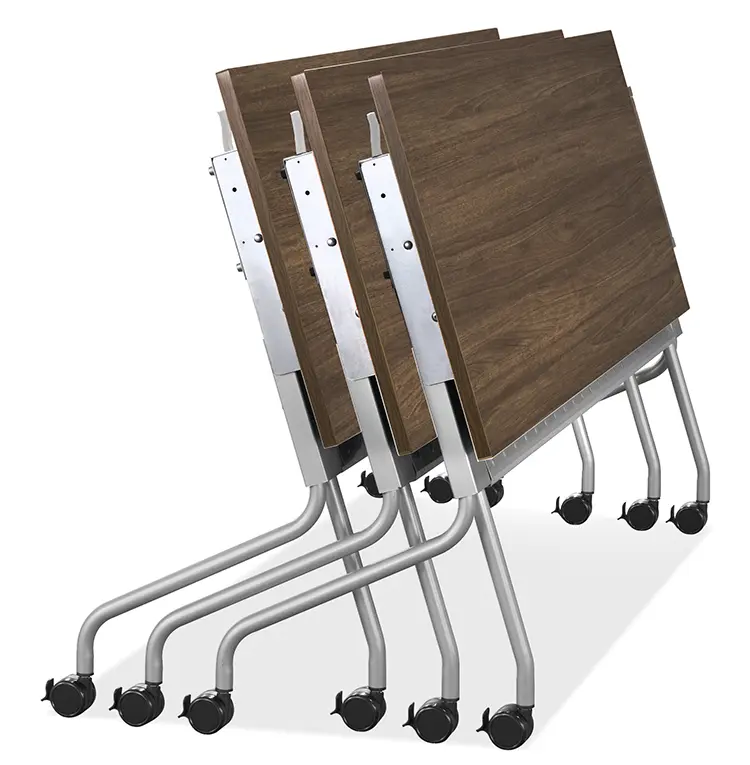
The PBD Furniture 60-inch Flip Top Nesting Table is the Best Overall pick because it is the commercial training table specification that professional environments actually need: a 60-inch laminate surface with 3-mil dura edge protection, casters for single-person repositioning, and a flip-top A-leg mechanism that nests multiple tables compactly for storage without requiring a dedicated storage room or disassembly. At 60 inches wide and 24 inches deep, this table seats two people comfortably for laptop-based training, which is the universal training room requirement in contemporary corporate environments.
The 3-mil dura edge on the top perimeter is the same commercial-grade specification found on PBD’s desk and conference table lines — a high-impact PVC edge that resists chipping, scratching, and moisture infiltration at the most exposed perimeter of the surface. In a training room where tables are moved, reconfigured, and stacked regularly, edge protection is not an optional upgrade but a baseline requirement. The A-leg flip-top base is available in black or silver to coordinate with room finishes, and the casters allow repositioning by a single person without assistance.
For training rooms that reconfigure between classroom-style instruction, team breakout, and conference layout, this table is the workhorse pick. Available in multiple contemporary laminate finishes. Ships in five business days with free delivery and our Free Lifetime Warranty.
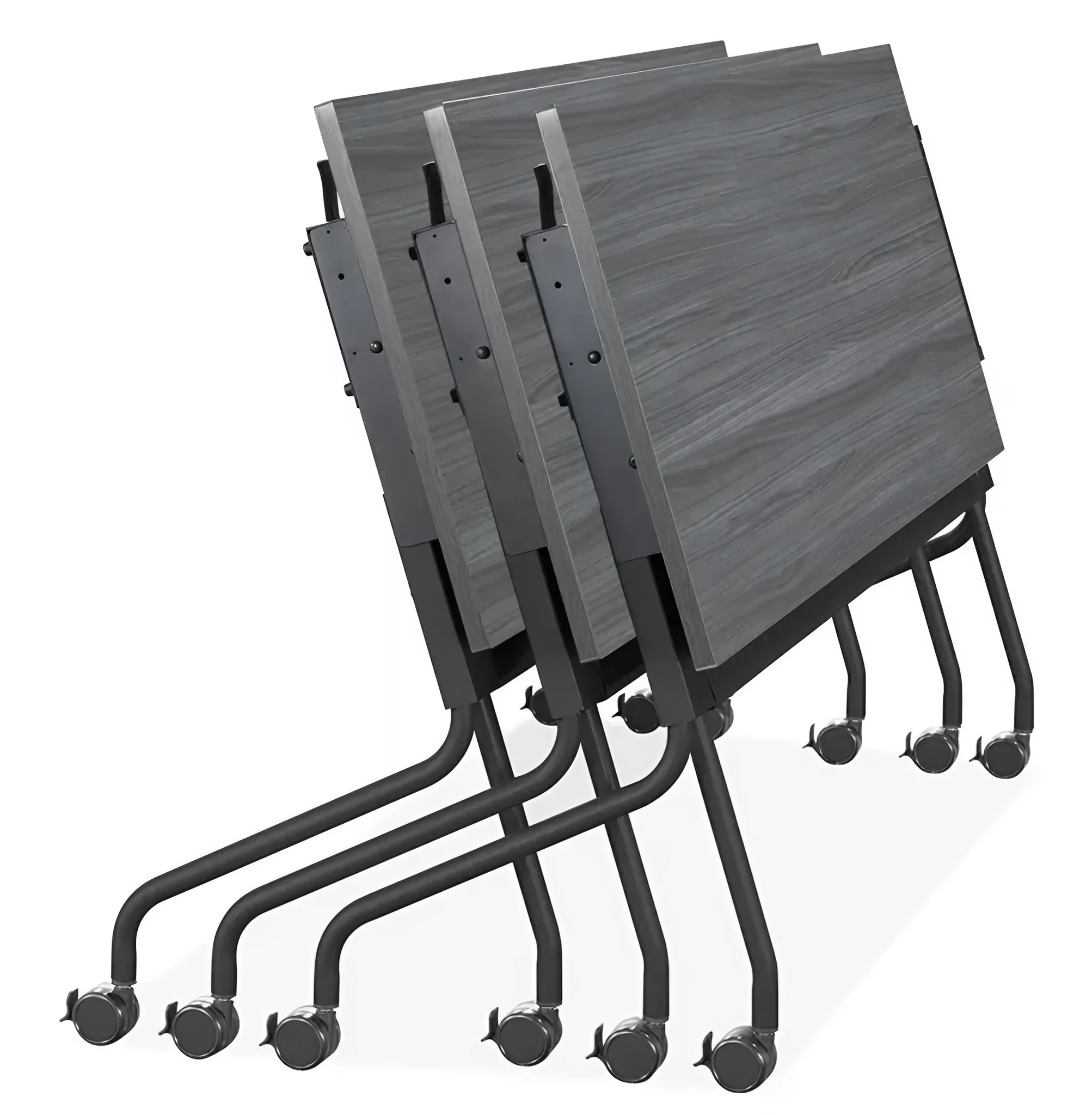
The PBD Furniture 48-inch Flip Top Nesting Table is the Best Value pick for rooms where a single workstation per table is the intentional design — focused individual learning environments, testing rooms, or tight training spaces where 60-inch tables would exceed available planning modules. At 48 inches wide, this table is designed for one person: it provides ample surface for a laptop, notebook, and reference materials without the extra 12 inches of table that would otherwise go unused at a single seat.
The identical construction specification to the 60-inch Best Overall pick — 3-mil dura edge, A-leg flip-top base, casters, laminate surface — means the only difference is the width reduction. This matters for nesting efficiency: 48-inch tables nested together take less linear storage space per unit than 60-inch tables, which is a meaningful advantage in rooms that also store chairs, AV equipment, or other furniture. The Coastal Gray finish pairs cleanly with the black powder-coated A-leg base, creating a contemporary neutral that works in corporate, educational, and healthcare training environments.
Note: the product image shows the 60-inch version — the 48-inch configuration is otherwise identical in construction and finish options. Ships in five business days with free delivery and our Free Lifetime Warranty.
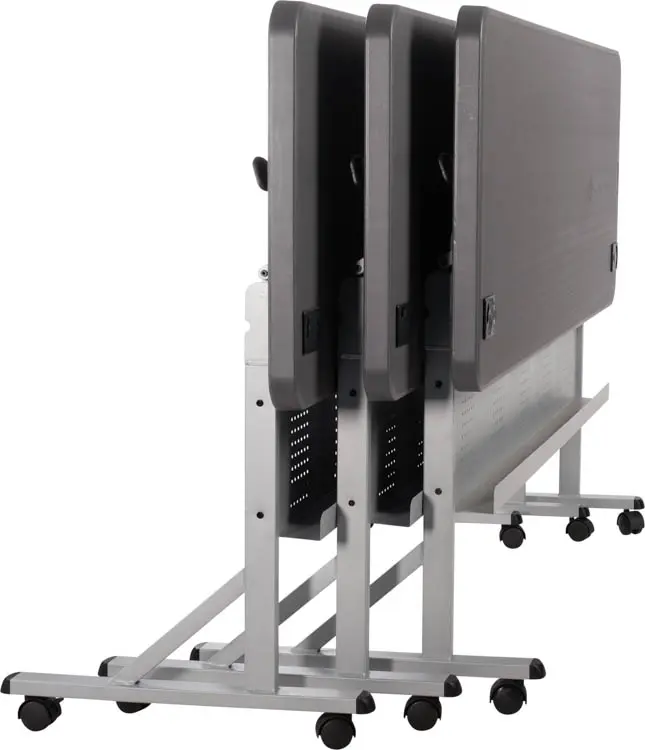
The National Public Seating Flip-n-Store Nesting Training Table earns the Best Budget designation by offering a 700-pound weight capacity, MAS Certified Green construction, built-in wire management, and a steel frame that genuinely withstands the rough handling common in high-volume institutional settings — at a lower entry point than laminate-top equivalents. The HDPE blow-molded plastic top is lightweight at 58 pounds total, which means single-person setup and breakdown is achievable even when the person doing it is not a facilities professional.
The 700-pound rated capacity is a standout specification that exceeds the rating of most laminate training tables in its class. The dual-lever flip mechanism allows the tabletop to be folded with one hand while the other steers the table into the nested position. Two grommet holes in the surface and a built-in cable channel in the modesty panel allow power cords and laptop cables to be routed without running across the floor. Four 2-inch casters with two locking provide stable positioning during sessions and easy movement when reconfiguring.
This table is the right choice for schools, community centers, houses of worship, event venues, and any organization that needs to move and reconfigure furniture frequently without dedicated facilities staff. For corporate environments where surface formality matters, the laminate-top PBD picks are preferable. Ships in five business days with free delivery and our Free Lifetime Warranty.
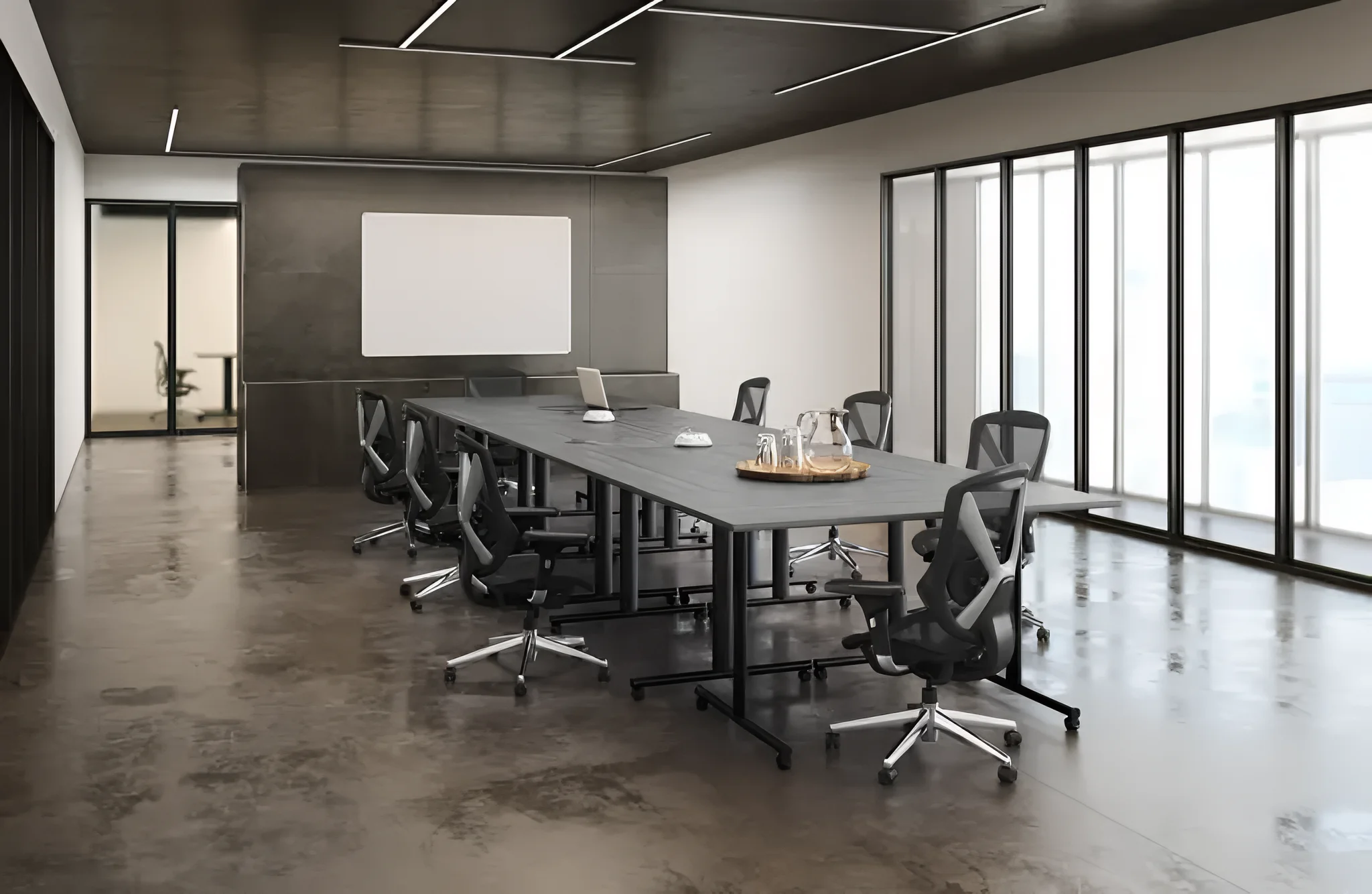
The PBD Furniture 16-foot Configurable Conference Table is the Best Premium pick for executive training suites, corporate seminar rooms, and boardroom environments that need a large, permanent training surface with the visual authority of a conference table rather than the utility-grade appearance of individual flip-top tables. At 16 feet by 60 inches, assembled from a kit of six rectangular tops, two end tops, and sixteen T-bases, this configurable system creates a continuous 192-inch surface that reads as a single custom conference installation while retaining the ability to reconfigure or expand with additional modular components.
The thermally fused laminate finish and impact-resistant edges are the same commercial-grade construction found throughout PBD’s contract furniture line. Unlike standard laminate, thermally fused laminate bonds the decorative layer directly to the substrate under heat and pressure, creating a surface that resists the scratching, staining, and edge chipping common in high-use training environments. The black T-bases provide a strong visual contrast against lighter finish options and a refined, contemporary appearance appropriate for senior executive training programs and client-facing seminar rooms.
Available in multiple laminate finishes. Seating and accessories not included. Ships in five business days with free delivery and our Free Lifetime Warranty.
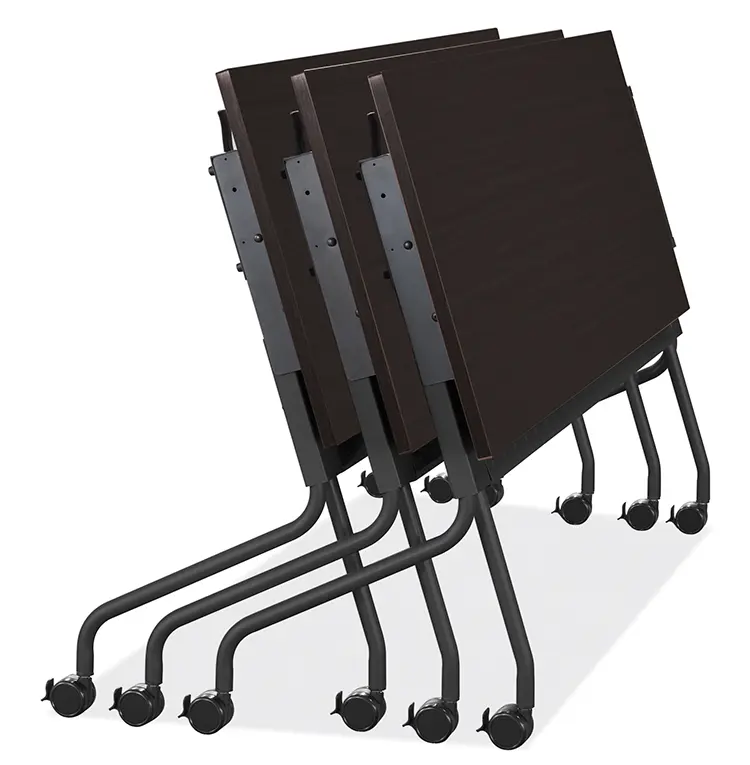
The PBD Furniture 6-foot (72-inch) Flip Top Nesting Table is our most frequently ordered training table, and the width explains why. At 72 inches, this table seats two people with the most generous per-person surface allocation available in a standard training table format — 36 inches each — which accommodates a laptop, an open notebook, reference materials, and a water bottle without crowding. For training programs where participant experience and professional impression matter, the additional surface space communicates consideration and preparation in a way that visibly cramped stations do not.
The identical construction specification to the 60-inch Best Overall — 3-mil dura edge, A-leg flip-top mechanism, casters — is maintained at the 72-inch width, with the expected weight increase to 102 pounds. The Espresso finish with black legs is a rich, professional combination that photographs well and holds up visually in both high-end corporate training centers and more utilitarian learning environments. Available in multiple finish and base color combinations. Ships in five business days with free delivery and our Free Lifetime Warranty.
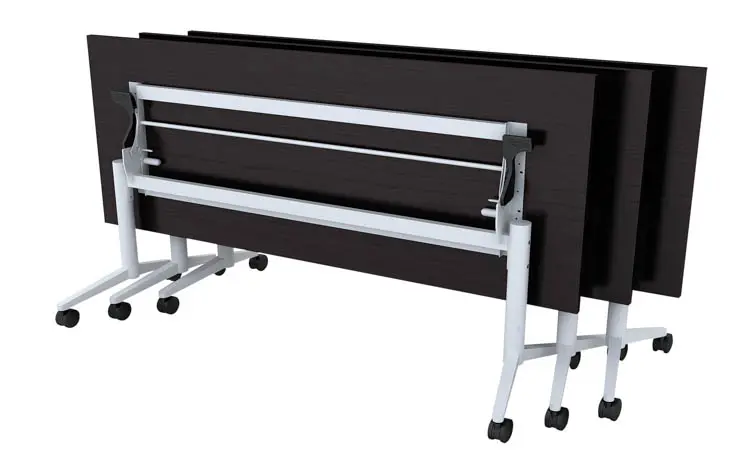
The PBD Furniture 60-inch by 30-inch Y-Leg Flip Top Nesting Table earns the Runner-Up position by offering the same 60-inch width as the Best Overall pick at a deeper 30-inch surface, with a Y-leg base configuration that provides broader lateral stability for rooms where tables are used in permanent or semi-permanent arrangements as much as in frequently reconfigured training layouts. The 30-inch depth is a meaningful upgrade for laptop-heavy training environments: it allows a laptop to be positioned at a slightly greater distance from the user, which reduces neck strain during extended sessions and accommodates a larger reference document between the keyboard and the table edge.
The Y-leg base is available in three colors — Silver, White, and Black — giving this table the broadest base color selection of any pick in this guide. The White base option is particularly useful for modern, light-palette training environments where standard black or silver bases would visually compete with the room’s design intent. The 3-mil dura edge surface specification and nesting caster mechanism are the same as the full PBD training table line. Ships in five business days with free delivery and our Free Lifetime Warranty.
The flip-top mechanism is the most-used moving component on any training table. It should lock securely in both the open (flat) and closed (vertical) positions and release smoothly under normal operating force. Single-lever mechanisms that require both hands to operate are a facility management problem in practice; dual-lever designs allow one-handed release while the other hand steadies the table.
Measure your storage space before ordering. Tables nest together in rows, and the storage depth per table in the nested position varies by base design. A-leg bases nest more efficiently than Y-leg bases for most configurations. Plan for at least 12–15 inches of storage depth per nested table to calculate how many units will fit in your available storage corridor or closet.
Training tables move in every direction during reconfiguration. Casters should roll freely on any standard commercial flooring (carpet tile, VCT, hardwood laminate) and lock reliably when engaged. Casters without locks drift during sessions and must be manually repositioned repeatedly — an operational problem that compounds across a full room of tables.
A 24-inch surface depth is the space-efficient standard for most training room configurations. A 30-inch depth provides more comfort for laptop users and allows greater flexibility in peripheral arrangement, but reduces how many rows fit in a given room length. Choose 30-inch depth if participant experience during extended training sessions is the priority, and 24-inch depth if room capacity and nesting efficiency matter more.
In any training room with laptops or charging devices at the stations, wire management at the table is essential. Look for surface grommets and/or modesty panel cable channels that route power cords from the desk surface to below-table power strips without creating floor-level trip hazards.
Laminate tops project a professional appearance appropriate for corporate training environments. Plastic (HDPE) tops are lighter, more resistant to rough institutional handling, and easier to clean after heavy use. Choose based on the training environment’s use intensity and visual standards, not on surface durability alone — both materials are long-lived when correctly specified.
A flip-top nesting training table has a tabletop that pivots 90 degrees to a vertical position, reducing the table’s depth footprint from its full working depth to the width of the base only. Once flipped, multiple tables can be rolled together and nested in a compact row, typically occupying 60–70% less floor space than the same number of tables set up for use. Casters allow repositioning without lifting, which is essential for single-person setup.
A 60-inch by 24-inch training table comfortably seats two people side by side at 30 inches per person, which is the standard spacing for laptop use. At 24 inches per person, three people can technically be seated, but this is crowded for any sustained work session. For training rooms equipped with laptops at every seat, plan for 60 inches per two participants.
Standard training table height is 29–30 inches, consistent with standard desk and conference table height. This coordinates with the majority of stacking and nesting chairs set to a standard seated working height. All six picks in this guide are standard height.
A-leg bases are the most common commercial training table configuration and nest most efficiently. Y-leg bases offer a wider lateral footprint and slightly more surface stability, at the cost of slightly reduced nesting efficiency. For standard training room applications, A-leg is the practical default. Y-leg bases are a good choice for rooms where tables are frequently used in standalone or conference configurations.
Laminate tops are the standard for professional training environments because they provide a more formal appearance and a harder writing surface. HDPE blow-molded plastic tops are appropriate for high-volume institutional settings where weight, durability under rough handling, and a lower per-unit cost are more important than surface formality. For corporate training rooms, laminate is the professional standard.
For a 16-person training room, the standard configuration uses eight 60-inch flip-top tables arranged in two parallel rows of four, each table seating two participants. This provides 30 inches of surface per person for laptop work and leaves an aisle of at least 48 inches between the back of one row’s chairs and the front of the next row’s table edge. The flip-top nesting feature makes reconfiguration between formats quick and achievable without specialized labor.